 Available 24 hours, 7 days a week
02 9199 7430
Click To Request a Quote
Available 24 hours, 7 days a week


Updated for 2026 by the licensed team at Graham & Sons Plumbing, based on current Sydney pricing, real job data, and NSW regulatory requirements.
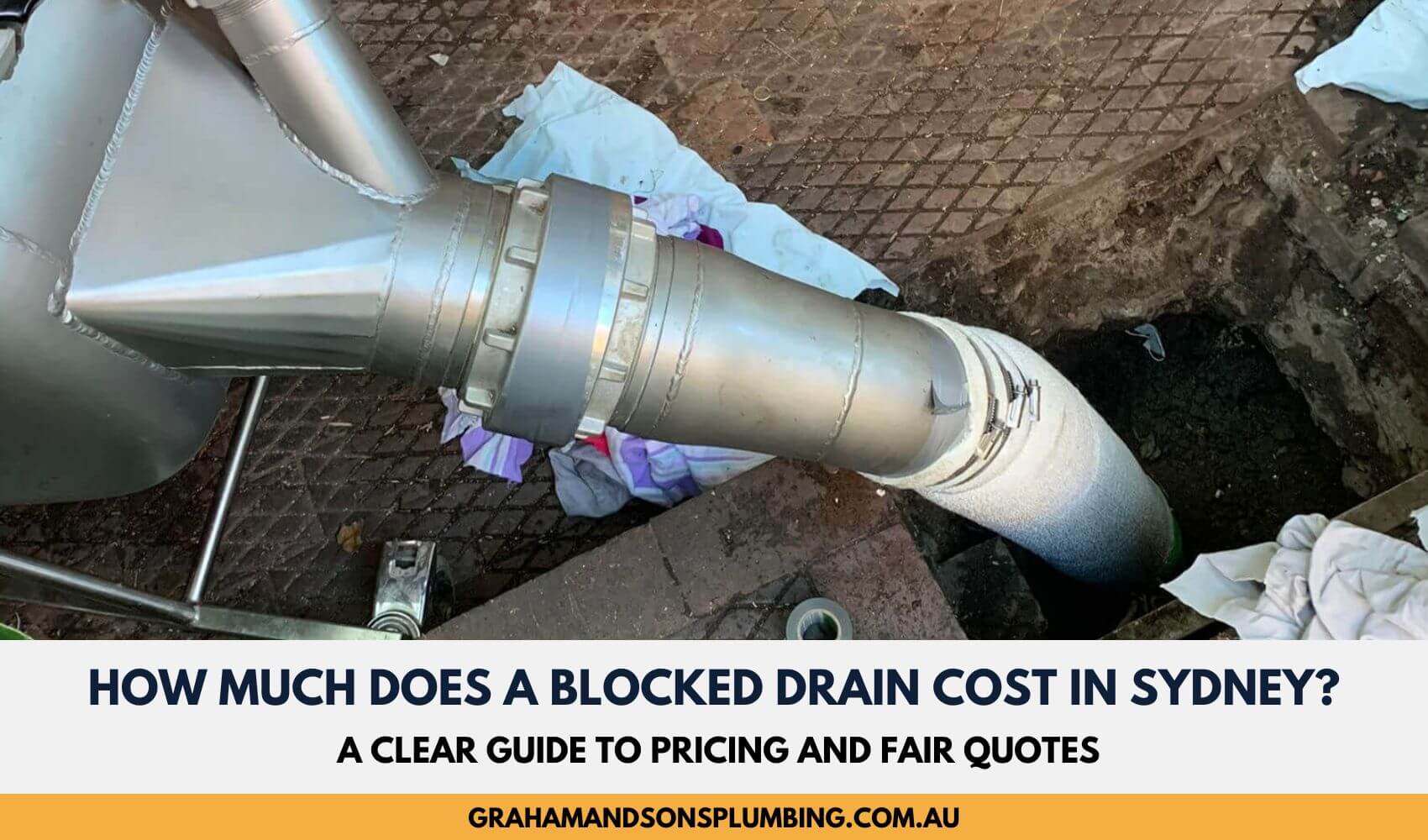
Blocked drains are stressful. Most people searching this want one thing first:
How much is this going to cost me?
We’ll answer that clearly, then explain why prices vary, what a fair quote looks like in Sydney, and when you should be concerned.
In Sydney, most standard blocked drain jobs fall within a fairly predictable range. Here’s what we typically see across homes in different suburbs:
Sink or shower drain: $150–$300: Usually includes basic clearing with a machine or snake and a short labour time.
Toilet blockage: $180–$350: Typically involves manual or mechanical clearing.
Kitchen grease build-up: $200–$400: Often requires machine clearing and sometimes partial jetting.
Main sewer line blockage: $300–$800+: Usually involves jetting, heavier equipment, and more labour.
After-hours emergency: $450–$900+: Includes call-out fee plus premium labour rates.
Blocked drains that occur due to ongoing maintenance issues or preventable causes often aren’t covered by home insurance policies, which means homeowners typically pay out of pocket, a nuance that becomes clear when looking at what plumbing issues aren’t covered by insurance.
A few important points:
If you are seeing ads promising drain clearing for $69 or $99, that figure almost never reflects the final invoice. Those prices usually cover only the initial visit or a very basic attempt at clearing.
Now let’s look at why costs vary so much.
This is where most confusion comes from.
Two people in Sydney can both have “a blocked drain”, yet one pays $250 and the other pays $2,500. The difference is usually one of the following.
A blockage in a bathroom basin is usually quick to access.
A blockage in the main sewer line, under a concrete slab, beneath a driveway, or near the street connection, will take longer, require more equipment, and increase cost.
Location matters more than most people realise.
Common causes we see across Sydney:
Grease and hair are usually cheaper to clear.
Tree roots or damaged pipes are different. They often require high-pressure jetting, CCTV inspection, or pipe repair or relining.
Once structural damage is involved, you move from a “clearing job” to a “repair job”. That is when pricing increases significantly.
Not all blocked drains are cleared the same way.
Here’s a simple breakdown:
If a job requires jetting and camera inspection, the cost will naturally be higher than a simple machine clear.
In Sydney, especially in older suburbs, access can be a real issue.
Tight side passages, long pipe runs, raised homes, or heavily landscaped yards increase labour time. More time means higher cost.
You are not just paying for equipment. You are paying for the time it takes to safely reach and fix the problem.
After-hours pricing in Sydney is standard practice. Plumbers charge normal rates during weekday business hours, but evenings and weekends are typically 30 to 60 per cent higher. Late night call-outs and public holidays can cost up to double the standard rate.
If sewage is backing up into your home at 10pm on a Sunday, that job will naturally cost more than the same issue handled on a Tuesday morning. That does not mean you are being overcharged. It reflects emergency labour costs and the availability required outside normal hours.
Many people worry about being taken advantage of. A fair quote should remove that uncertainty. Before work begins, you should clearly understand whether there is a call-out fee, the labour rate or fixed price structure, any equipment charges, whether CCTV inspection is included or optional, the exact scope of work being carried out, and what happens if further damage is discovered.
If the job is large, particularly over $5,000, NSW law requires a written contract. Deposits are capped at 10 per cent, and any changes to the scope must be agreed in writing. You should never feel pressured into approving excavation or major repairs without a clear explanation of why they are necessary.
A professional plumber should be able to clearly answer:
If those answers are vague, that is a warning sign.
Blocked drains are one of the most aggressively advertised plumbing services in Sydney. Not all advertising reflects reality.
Be cautious if you see:
Very low advertised prices often rely on upselling once the technician is onsite.
A fair service explains likely cost ranges upfront and confirms pricing before proceeding.
Not every blockage requires immediate attendance. Some can wait until business hours.
Use this as a guide.
Usually safe to book during normal hours.
Should be addressed soon to prevent escalation.
This requires immediate attention.
If you are unsure where your situation sits, we built a simple Blocked Drain Severity Checker Tool to help you decide.
It walks you through:
It is designed to remove guesswork, especially when you are unsure how serious the issue is.
Most blocked drains are resolved with clearing alone.
Sometimes they are not.
In many older Sydney suburbs, we frequently see:
In these cases, clearing the blockage only removes the symptom. The structural issue remains.
Here is how that changes things.
High-pressure jetting can cut and clear roots.
But if the pipe joint is damaged, roots will likely return.
Long-term options may include:
If the pipe is cracked or collapsed
This moves beyond drain clearing.
Options may include:
This is where jobs can reach several thousand dollars. It is not the norm, but it does happen.
The key difference is simple: Clearing removes a blockage. Repair fixes the underlying damage.
Recurring blockages are one of the biggest frustrations for homeowners. You clear it, then three months later it is back. The goal is not just to open the pipe, but to stop the problem returning.
If a drain keeps blocking, guessing becomes expensive. A CCTV inspection confirms whether roots are present, whether the pipe has cracks or damage, and whether the issue is isolated to one section or affecting the broader system. Without proper diagnosis, you are simply repeating the same clearing process and hoping for a different result.
A basic machine clear may reopen a pipe temporarily, but it does not always clean it thoroughly. High-pressure jetting cleans the pipe walls, removes built-up sludge, and reduces the likelihood of immediate recurrence. Not every blockage requires jetting, but some do. Using the appropriate method makes a significant difference to long-term results.
If small cracks or joint gaps are identified early, pipe relining can prevent major excavation, complete pipe collapse, and repeated emergency call-outs. Structural issues do not fix themselves. Small problems are always less costly to manage than major failures discovered later.
Slow drainage, gurgling sounds, and occasional unpleasant smells are early signals. They are not harmless quirks. Addressing them during business hours is usually far cheaper and far less stressful than waiting until a full backup forces an emergency response.
Many people try DIY first, which is reasonable for minor issues. Using a plunger, removing visible hair from shower drains, cleaning sink traps, or carefully using a manual drain snake can sometimes resolve simple blockages. Basic tools are inexpensive and may solve straightforward problems.
You should stop and call a licensed plumber if multiple fixtures are affected, water levels rise in the toilet when other taps run, the blockage keeps returning, you suspect tree roots, or you hear gurgling across the house. Chemical drain cleaners are rarely a long-term solution and can damage pipes, particularly older ones, while also creating safety risks.
In NSW, drainage work must be carried out by a licensed plumber. Using unlicensed contractors can void insurance and expose you to compliance issues.
If you are unsure, it is usually safer and more cost-effective in the long run to have the problem assessed properly.
When you book a blocked drain service, you should expect clarity.
At Graham & Sons Plumbing, our approach is straightforward:
The goal is not to sell complexity. It is to make the situation clear so you can make an informed decision.
Blocked drains are stressful enough. Pricing should not add confusion.
If you remember nothing else from this guide, remember this. In Sydney, most standard household blockages cost between $150 and $400. Main sewer blockages often fall between $300 and $800 or more, depending on severity and access.
Structural repairs such as pipe relining usually start around $1,500 and increase based on length and location. After-hours emergencies are more expensive, and that is normal.
If you understand where the blockage is located, what is causing it, what equipment is required, and when the work is being done, you can quickly judge whether a quote is reasonable. Clarity reduces stress. When you know what drives plumbing cost, you can move forward confidently, whether that means booking a standard service or arranging urgent assistance.
In our experience working across Sydney homes, the majority of blocked drains are resolved within the lower end of the typical range. It is usually the underlying structural issues, not the blockage itself, that significantly increase the final cost.

* Between 8.30am - 5.00pm, Monday to Friday.

