 Available 24 hours, 7 days a week
02 9199 7430
Click To Request a Quote
Available 24 hours, 7 days a week

Water Damage Is No Longer Occasional; It Is a Common Risk for Australian Homes
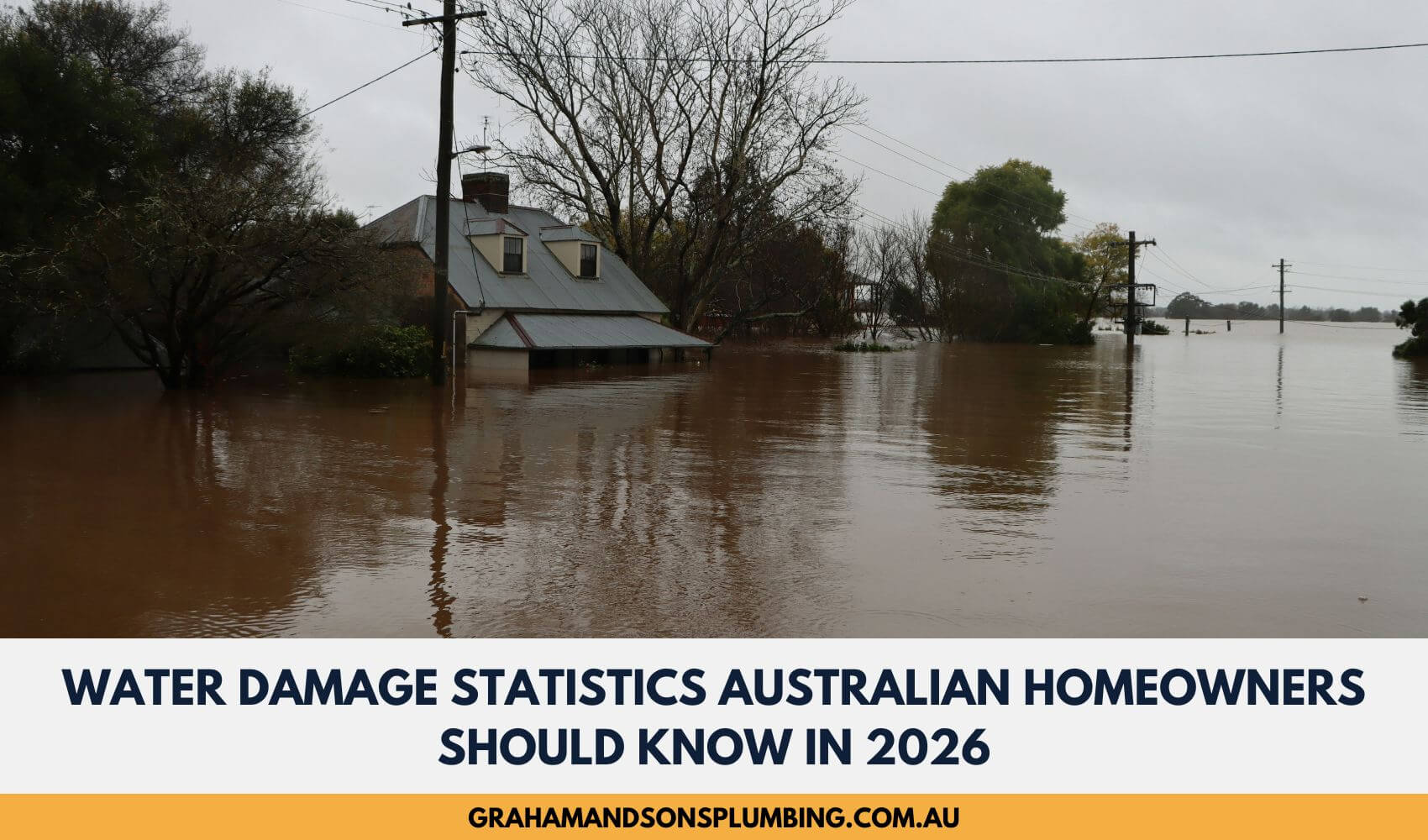
Water damage used to be something homeowners associated with major storms or rare plumbing failures. That is no longer the case.
Across Australia, the scale of the problem has grown sharply. In 2025 alone, extreme weather events generated 264,000 insurance claims and $3.5 billion in losses, making water-related damage one of the largest cost drivers for insurers. That figure does not include the thousands of smaller, everyday incidents happening inside homes.
At a household level, the exposure is even clearer. Around one in two Australians have experienced water damage directly or know someone who has, which means most homeowners are only one incident away from dealing with it themselves.
Insurance data reinforces the same point. Water-related incidents now make up approximately 24% of all home insurance claims, placing them among the most common issues homeowners face.
From a practical perspective, this aligns with what is seen on the ground. Many of the jobs handled by plumbers that Sydney homeowners rely on are no longer isolated emergencies. They are part of a steady flow of leaks, pipe failures, and water-related issues that occur every day across residential properties.
Large-scale events still play a major role in shaping the overall numbers.
Cyclones, floods, and severe storms continue to drive spikes in claims. Individual events can generate over 95,000 insurance claims, showing how quickly damage can spread across entire regions.
One example stands out. Ex-Tropical Cyclone Alfred resulted in 132,000 claims and more than $1.5 billion in losses, highlighting how a single event can create widespread financial impact.
What makes this more concerning is how concentrated the risk is. Only 4.4% of properties are considered flood-prone, yet they generate a disproportionate share of claims. At the same time, around 675,000 properties face at least a 1% annual flood risk, meaning exposure is far from limited.
Over the past five years, extreme weather has contributed to $22.5 billion in insured losses, which puts into perspective how consistently these events are impacting homeowners.
There is also a clear operational impact. Storms and cyclones account for over 71.7% of emergency service incidents, which closely mirrors the number of water-related callouts seen across plumbing services.
The effect goes beyond repairs. Flood exposure has already reduced property values by more than $42 billion across over 2 million homes, showing that water risk is now influencing long-term property decisions.
Despite the focus on extreme weather, the majority of water damage happens inside the home.
Insurance data consistently shows that burst or blocked pipes are responsible for 46% of all water damage incidents, making them the leading cause.
Other contributors include:
Each of these accounts for a significant share of incidents, with roof damage and ageing plumbing each contributing over 27% of cases.
Across multiple datasets, one trend stays consistent. Burst pipes remain the number one cause of water damage in Australian homes.
Data from NRMA strengthens this further. It shows that 71% of water damage claims are linked to burst pipes, which means most incidents originate from internal plumbing failures rather than external events.
There are also smaller components that create disproportionate damage.
Flexible hoses, commonly found under sinks and behind appliances, are responsible for around 10% of water damage claims. When analysed at scale, around 30% of these hoses are at risk of failure, often without visible warning signs.
In real-world terms, this is where many issues begin. A minor leak behind a cabinet or inside a wall can go unnoticed for days. By the time it is discovered, the damage has already spread through the flooring, cabinetry, and internal structures.
This is where targeted water leak services become critical. Early detection often prevents what would otherwise escalate into a much larger repair.
The cost of water damage is rarely small. In many cases, it escalates quickly.
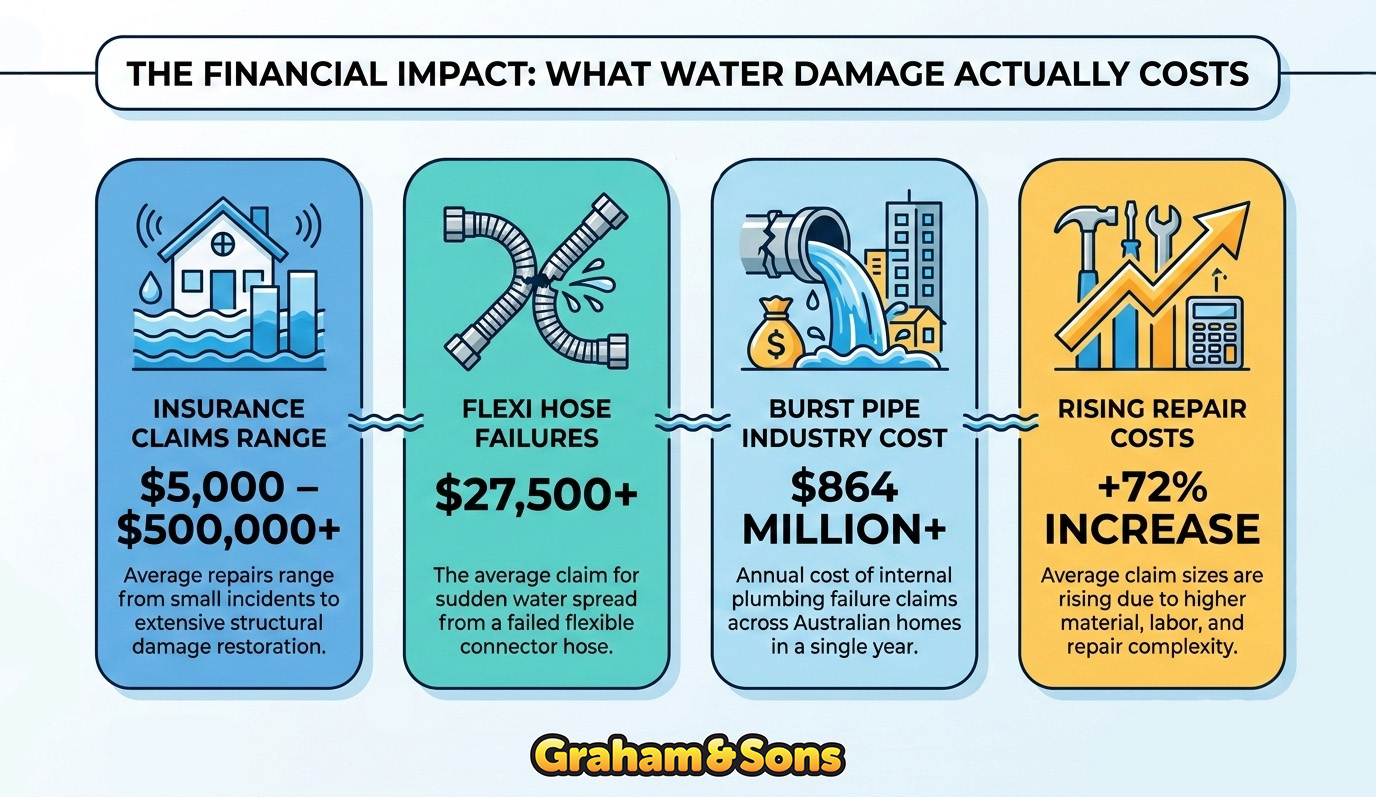
Insurance data shows that claims can range from $5,000 to more than $500,000, depending on the severity of the incident. Even relatively contained issues can lead to extensive repairs once moisture spreads through structural materials.
More commonly, homeowners face costs in the mid-range. More extensive water damage repairs can range from $5,000 to $10,000 or more, especially when structural elements, flooring, or internal systems are affected.
Some of the most surprising costs come from smaller components. A failed flexi hose, for example, results in an average claim of over $27,500, often due to rapid water spread before detection.
At an industry level, the numbers are even more significant. Burst pipe incidents alone contributed to $864 million in claims within a single year, showing how costly internal plumbing failures are at scale.
Costs have also increased over time. Average claim sizes have risen by 72%, reflecting higher material costs, labour, and more complex repairs.
Water damage is now considered more common and more expensive than fire or burglary claims, which marks a clear shift in household risk priorities.
From a practical standpoint, many of these situations escalate because of timing. A small leak left unattended often turns into a major issue within hours or days. Once water starts spreading, the situation frequently requires emergency plumbing services to stop further damage and stabilise the property.
A large portion of water damage does not come down to bad luck. It comes down to missed maintenance and low awareness.
Data from Allianz shows that 84% of homeowners do not carry out regular maintenance checks, leaving plumbing systems and fixtures to deteriorate unnoticed. That level of inaction creates the conditions for sudden failures, particularly in older homes.
Even more telling, two in five homeowners neglect maintenance entirely, which significantly increases the likelihood of issues such as burst pipes, leaking fittings, and internal water damage.
There is also a clear knowledge gap.
More than 58% of Australians do not understand the term “escape of liquid”, despite it being one of the most common categories in insurance claims. In simple terms, it refers to water escaping from pipes, fixtures, or appliances inside the home, which is exactly where most damage begins.
Many homeowners also fail to recognise early warning signs such as minor damp patches, reduced water pressure, or unusual smells. These are often dismissed as minor issues, allowing damage to develop behind walls, under flooring, or inside cabinetry before it becomes visible.
From experience, many of these situations follow a consistent pattern. A minor issue, often ignored at first, develops into something far more serious. A slow leak under a sink, a worn-out hose behind a washing machine, or a small crack in a pipe can go unnoticed until water has already spread into surrounding materials.
Regular inspections from a qualified plumber Sydney homeowners trust can prevent most of these outcomes. Identifying early signs of wear or failure is often the difference between a minor repair and a major insurance claim.
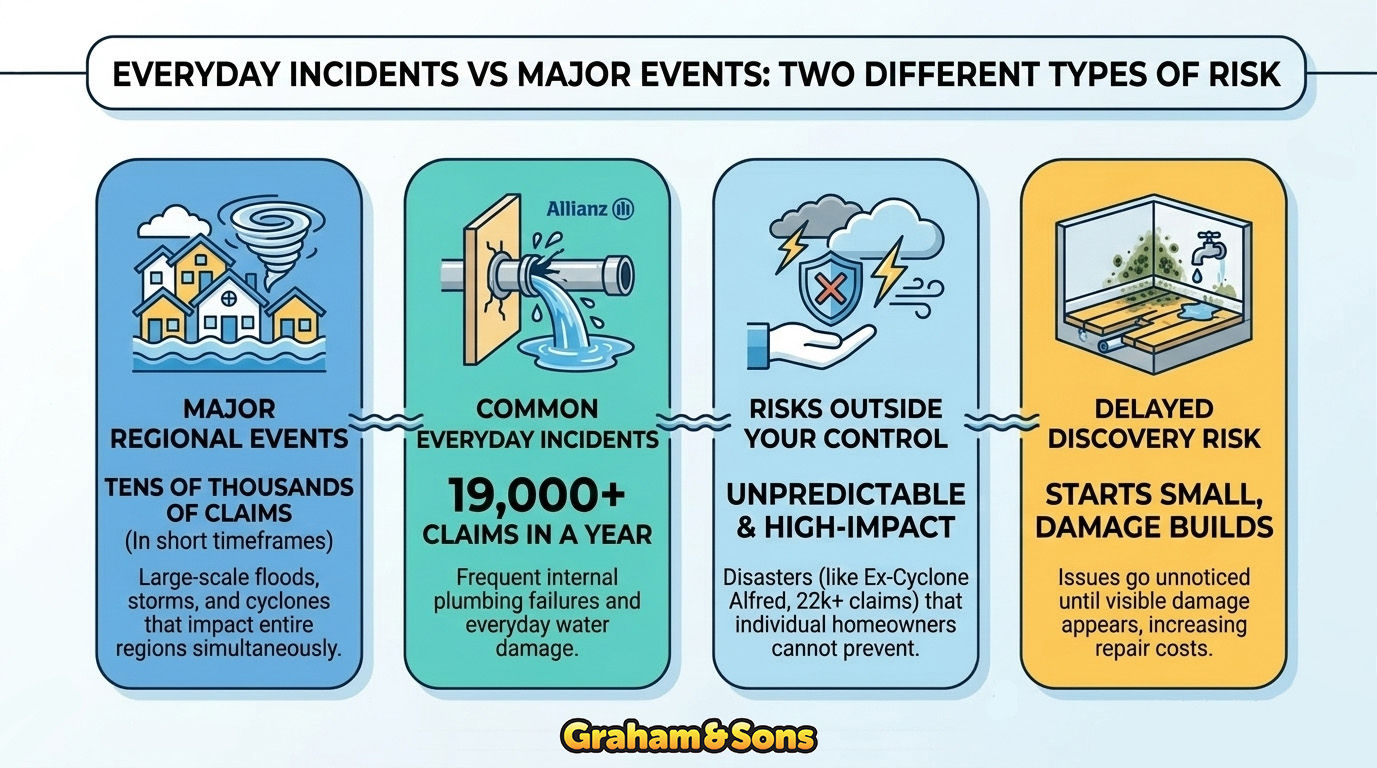
Water damage in Australia sits across two distinct categories, and understanding the difference matters.
On one side, there are large-scale events. Floods, storms, and cyclones generate tens of thousands of claims within short timeframes, often impacting entire regions at once. For instance, insurers received more than 22,000 claims within days of Ex-Tropical Cyclone Alfred, with numbers expected to rise as affected areas reopened. These events are unpredictable, high-impact, and largely outside the control of individual homeowners.
On the other side, there are everyday incidents. These are far more common and far more preventable.
Data from Allianz shows that insurers handled over 19,000 claims involving burst pipes and water damage within a single year, reinforcing how common internal plumbing failures are compared to large-scale disaster events.
In practical terms, most homes are more likely to experience a leaking pipe than a flood event. The difference is that internal issues often start small and go unnoticed, which allows damage to build over time.
From what is seen across Sydney properties, the pattern is consistent:
By the time the problem is obvious, it often requires urgent intervention. Many of these cases end up needing emergency plumbing services, not because the issue started as an emergency, but because it was left unresolved.
Understanding this distinction is critical. Catastrophic events drive headlines, but everyday plumbing failures drive the majority of real-world damage.
The data points to a clear conclusion. Water damage is not just increasing; it is becoming a normal part of home ownership.
The risk now comes from two directions at once. External factors such as extreme weather continue to drive large-scale losses, while internal plumbing failures create a constant, ongoing source of damage inside homes.
What stands out is where most of the control sits.
The majority of incidents originate from within the property. Pipes, fittings, hoses, and fixtures account for a significant share of damage, and these are all areas that can be monitored, maintained, and replaced before failure occurs.
At the same time, costs are rising. Repairs are more expensive, claims are larger, and even minor issues can lead to significant financial impact if left unchecked.
The takeaway is straightforward.
Water damage is no longer something to react to. It is something to actively manage.
That means:
Engaging the right services at the right time plays a key role. Early-stage issues are best handled through targeted water leak services, while more serious situations require immediate response through emergency plumbing services.
In both cases, working with an experienced plumber Sydney homeowners can rely on reduces risk, limits damage, and helps avoid costly repairs.
Ignoring small issues is what turns them into large ones. Acting early is what prevents them from escalating.
That is the difference these statistics highlight, and it is where most homeowners still have the opportunity to stay ahead.

* Between 8.30am - 5.00pm, Monday to Friday.

